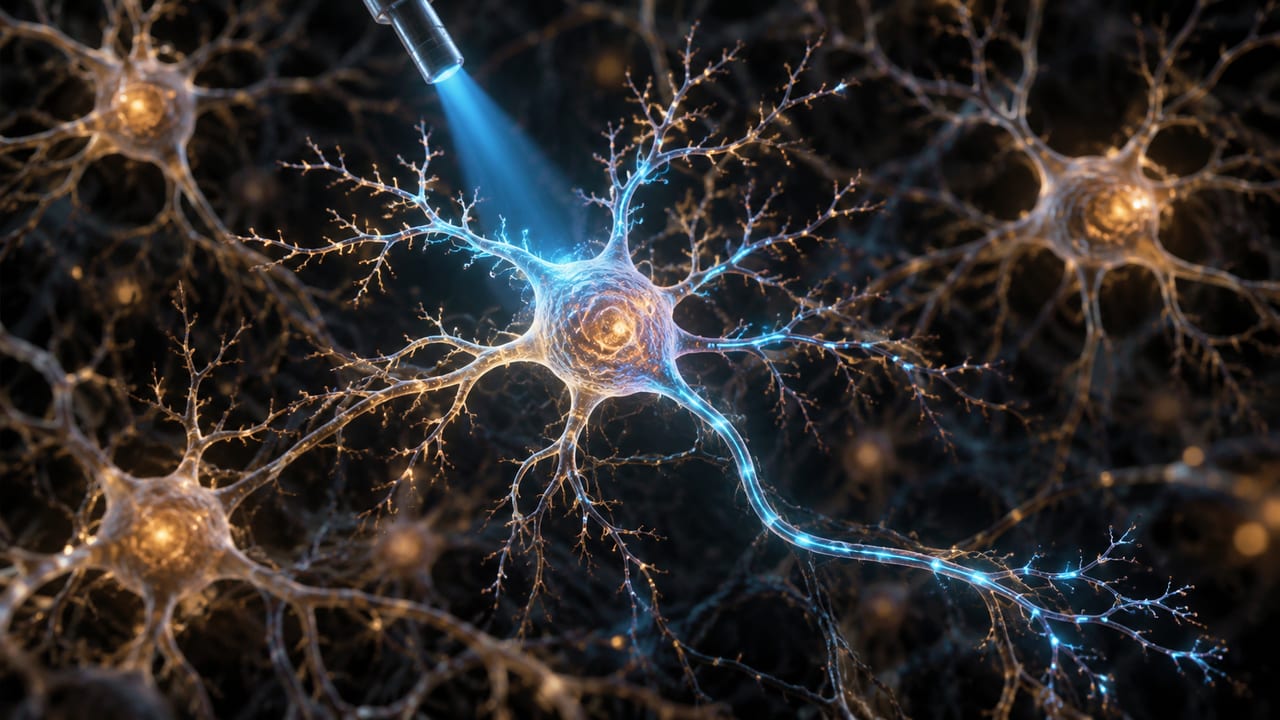
Light can do more than reveal a nerve cell. Given the right protein, it can change its electrical activity. On 5 October, the 2026 Nobel Prize in Physiology or Medicine recognised Karl Deisseroth, Peter Hegemann and Georg Nagel for discoveries concerning light-gated ion channels and optogenetics.
The route began with light-sensing algae. Channelrhodopsins became tools that researchers could introduce into selected cells and activate with timed illumination. Instead of merely watching activity accompany behaviour, scientists could test what changed when they intervened.
In this channelrhodopsin-2 example, suitable light opens cation channels and can depolarise an opsin-bearing neuron enough to trigger spikes. A control without that opsin lacks this channel-mediated response; both cells can have ongoing activity. Darkness removes the added drive, rather than actively inhibiting the cell. This is a schematic comparison, not recorded data.
The people behind the discovery


Karl Deisseroth
Stanford University
A psychiatrist and bioengineer, Deisseroth helped develop the use of microbial light-sensitive proteins to control selected mammalian neurons. His team's work turned a molecular discovery into an experimental method for testing what neural circuits do, rather than only observing when they become active.
Biography and contribution: source

Peter Hegemann
Humboldt University of Berlin
Hegemann investigated how single-celled algae respond to light. His work with Nagel helped establish channelrhodopsins as light-gated ion channels: proteins that couple illumination to electrical activity. The discovery supplied a crucial molecular foundation for optogenetics.
Biography and contribution: source

Georg Nagel
University of Würzburg
Nagel is a biophysicist who studied the electrical behaviour of light-sensitive proteins. With Hegemann and colleagues, he helped demonstrate channelrhodopsins' light-gated conductance. Their functional characterisation made it possible to understand how these proteins could confer light sensitivity on other cells.
Biography and contribution: sourceSchematic toy comparison: an opsin-positive cell and a control cell. Not a simulation of a whole brain.
For us, the achievement is a better causal question, not a claim to read minds. It requires controls and physical access for light delivery. A 2021 human vision report demonstrated partial recovery with treatment and specialised goggles in one patient, not normal sight or proof of routine clinical use.
This is the identical fact set, re-told at a different altitude. Switch any time — the reader keeps your place in the idea, not the prose.