Physics · Nobel Prize 2026

The universe left
a trace inside the ice.

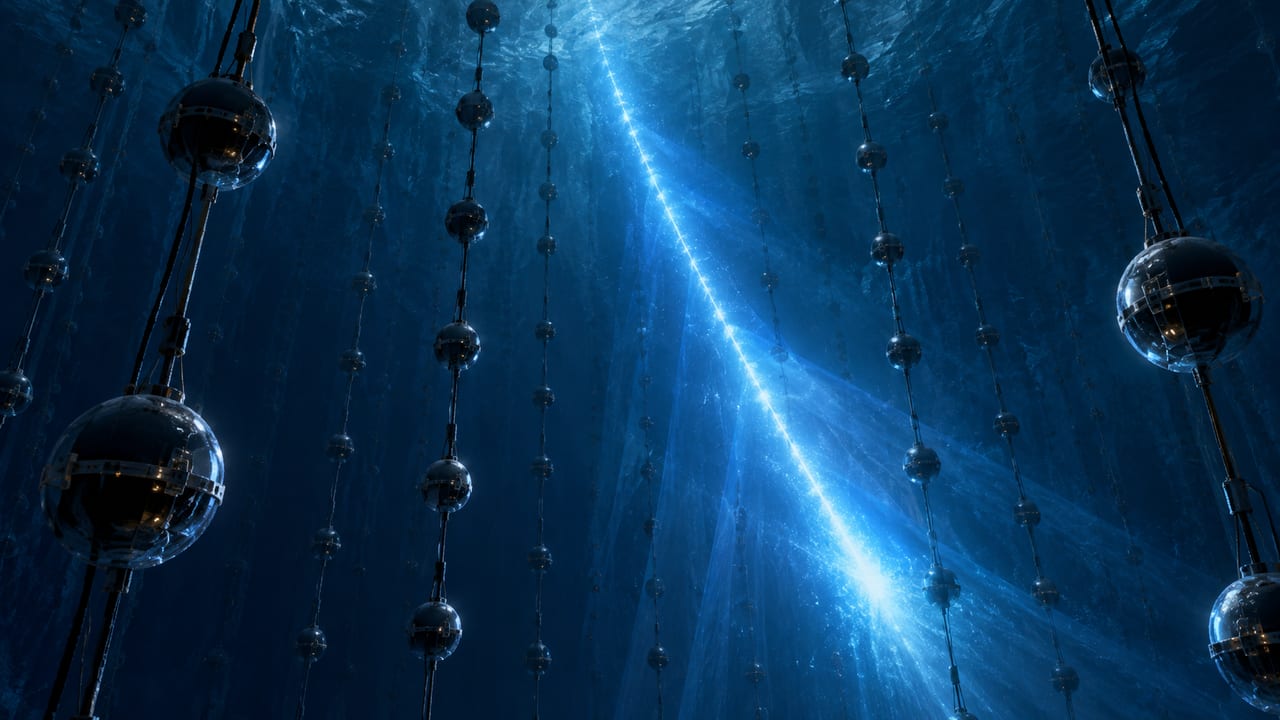
Francis Halzen's 2026 Nobel recognises an observatory that made rare neutrino interactions into astronomical evidence. A cubic kilometre beneath the South Pole opened a new view of cosmic particle accelerators.

Field  PhysicsEra  6 October 2026 CESubject  Francis Halzen · IceCubeBy  Celestium Editorial
Read at your altitude
The Glance — the essence in twenty seconds

Deep beneath the South Pole, IceCube records light produced when a neutrino interacts and creates charged particles in the ice. Most neutrinos pass through unseen. A cubic kilometre of instrumented ice gives the rare encounters somewhere to happen. On 6 October 2026, Francis Halzen received the Nobel Prize in Physics for his contributions to IceCube and the discovery of high-energy astrophysical neutrinos.

Schematic sequence: a neutrino interacts, charged secondary particles emit Cherenkov light, and sensors record it. Early boundary light can flag an entering muon; passing the veto alone does not establish a cosmic origin.

The people behind the discovery

Portrait of Francis Halzen
Mauro Mezzetto · CC BY-SA 4.0. Resized and re-encoded.

Francis Halzen

University of Wisconsin–Madison

A physicist whose work helped turn Antarctic ice into an astronomical instrument. Halzen proposed the approach behind IceCube in 1988 and became its scientific leader. The prize recognises high-energy neutrinos arriving from beyond our atmosphere; the detector itself is the achievement of a large international collaboration.

Biography and contribution: source
Why it matters

Neutrinos can carry evidence of cosmic particle acceleration through matter that obscures light. In 2013, IceCube found a population that atmospheric backgrounds could not adequately explain. Its outer sensors helped reject entering particles. The result established a diffuse cosmic signal; it did not identify individual sources. The 2018 blazar association was a further, qualified step. This discovery concerns known neutrinos, not the identity of dark matter, and belongs to an international collaboration.

From neutrino to signalInteractionParticlesLightSensorThe light comes from secondary particles.
A neutrino is inferred through the light its charged secondary particles produce. The sensor does not photograph the incoming neutrino. Original schematic · Celestium. Not to scale; no measured events are plotted.
Same discovery · depth 1 of 3

This is the identical fact set, re-told at a different altitude. Switch any time — the reader keeps your place in the idea, not the prose.

Sources & further reading

8 primary sources · checked against the original papers
  1. Royal Swedish Academy of Sciences; reproduced by FermilabNobel Prize in physics awarded to Francis Halzen for groundbreaking neutrino researchOfficial prize announcement reproduced by Fermilab, 6 October 2026
  2. IceCube Neutrino ObservatoryIceCube: Detector and ConstructionOfficial detector description, consulted October 2026
  3. IceCube Neutrino ObservatoryIceCube and NeutrinosOfficial science explainer, consulted October 2026
  4. M. G. Aartsen et al. (IceCube Collaboration)The IceCube Neutrino Observatory: Instrumentation and Online SystemsJournal of Instrumentation 12, P03012 (2017); arXiv record revised 2024
  5. M. G. Aartsen et al. (IceCube Collaboration)Evidence for High-Energy Extraterrestrial Neutrinos at the IceCube DetectorScience 342, 1242856 (2013)
  6. IceCube CollaborationSearch for contained neutrino events at energies above 30 TeV in 2 years of dataOfficial data release, 21 November 2013; updated December 2015
  7. IceCube, Fermi-LAT, MAGIC and partner collaborationsMulti-messenger observations of a flaring blazar coincident with high-energy neutrino IceCube-170922AScience 361, eaat1378 (2018)
  8. IceCube CollaborationNeutrino emission from the direction of the blazar TXS 0506+056 prior to the IceCube-170922A alertScience 361, 147-151 (2018)

Celestium retells peer-reviewed science for a general audience. Where a claim rests on a specific result, the primary work is cited above — read it at the source.